Loading…
Loading

 Douglas LivaUT-4717AJohn HillUT-383707AJesse GardnerUT-380938ARobert ValenciaUT-391234A
Loading
Fire Mitigation
October 7, 2026
After a mitigation crew opens up your property, what goes back in decides whether the work holds. USU Extension's Utah firewise plant list, the zone that is not a planting zone, the species to pull off your foundation, and the Park City code that may require replanting.
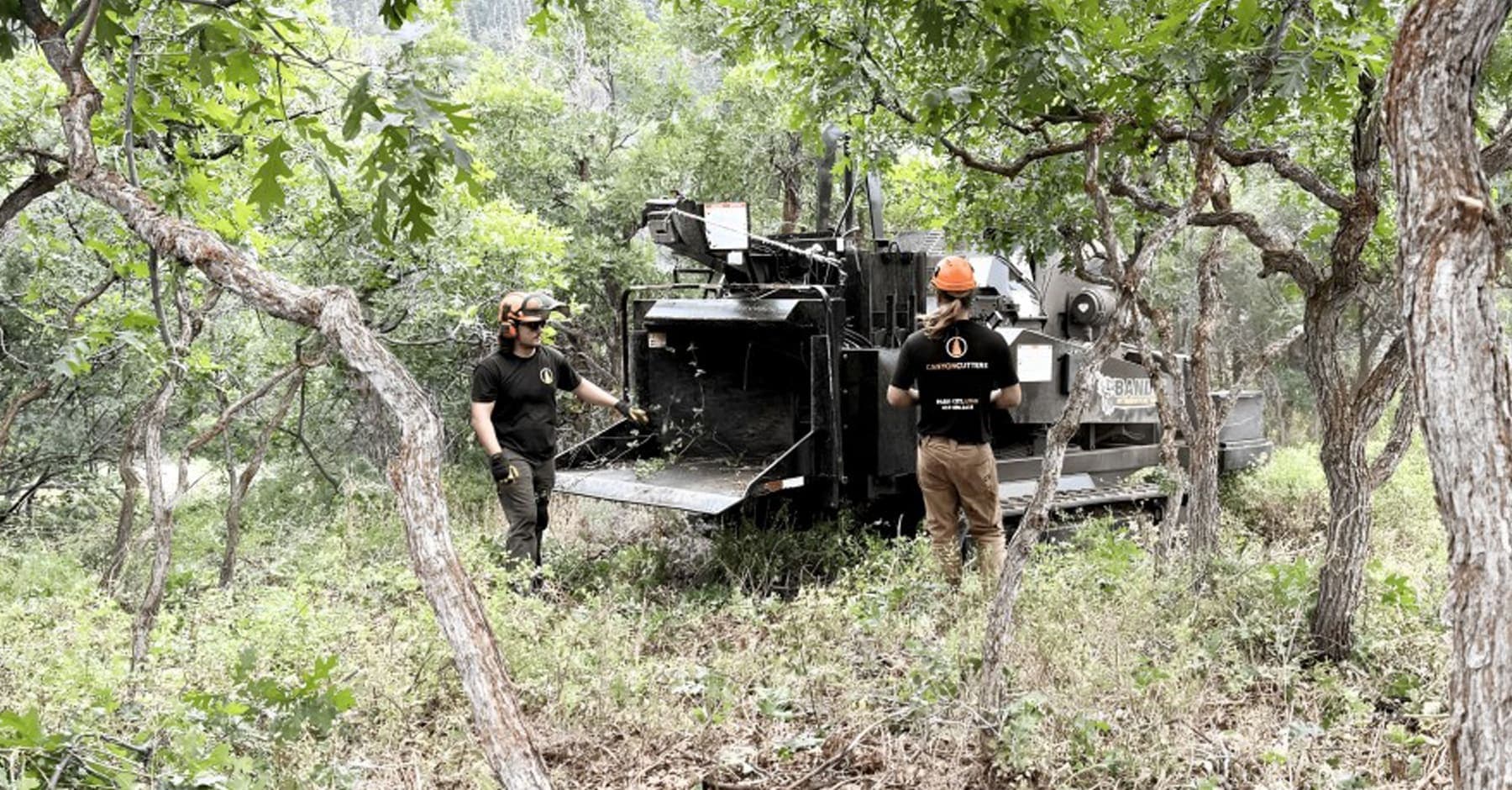
We do a lot of mitigation work on Park City properties. The crew thins the stand, takes out the dead conifers, pulls the junipers off the foundation, chips the slash, and the property is measurably safer than it was that morning.
And then the homeowner stands in the newly open space and asks the reasonable follow-up question: so what do I put back?
That question gets answered badly most of the time. The two common answers are both wrong. One is “nothing — bare ground is safest,” which produces an eroding, ugly, legally non-compliant lot that the owner comes to resent. The other is a nursery run that fills the space with whatever looked good on the lot, which on the Wasatch Back frequently means planting the exact species a mitigation crew just removed.
There is a real answer, and in Utah it is unusually well documented. Utah State University Extension publishes Firewise Plants for Utah Landscapes, compiled by the state Extension forester, and it is the closest thing to an authoritative species list for this climate. This guide works from it, adds the Park City code and elevation realities it does not cover, and is honest about the places the sources disagree.
USU states this plainly and it deserves to be the first thing you read. No plant is fireproof. All of them will burn in a sufficiently intense fire. Firewise plants reduce risk; they do not eliminate it, and using them alone does not make a property safe.
A second point from the same source matters just as much: all trees add substantial fuel. There is no tree you can plant that adds no fuel load. Which means the decisions that actually determine your outcome are placement and maintenance— where the plant sits relative to your structure, and whether anybody keeps the dead material out of it. Species selection is the third-most-important variable, not the first.
That is genuinely good news, because placement and maintenance are both entirely within your control and neither requires buying anything.
It is not a mystical property of certain species. Firewise plants share one or more measurable traits:
From those traits comes the most useful single generalization USU offers: broadleaf trees are generally less flammable than conifers— pines, firs, spruces, and junipers. On a Wasatch property dominated by conifer, deliberately adding broadleaf diversity is a defensible-space improvement and a bark beetle resilience improvement at the same time.
Before any species list, the zones. These drive the decision far more than the plant tag does.
This is the strictest zone and the one homeowners resist most, because it is the strip you see from inside the house. The guidance is consistent across fire agencies: this band should have very low potential for ignition from flying embers, which in practice means non-combustible ground cover — rock, stone, gravel, or pavers.
Two specific things to get out of this band:
You can still have plants near the house — low, well-watered, herbaceous, widely spaced, in containers you can move. What you cannot have is a continuous combustible bed touching the building.
Fire-resistant plants, non-combustible landscape features, and deliberate breaks in vegetation so there is no continuous fuel bed running at the house. This is where most of your actual planting design happens.
Remember that the ten-foot crown-separation rule applies to what you plant, not just to what you remove. A row of saplings installed four feet apart is a future code problem you are paying to create. Plant for the mature crown, not the nursery pot.
Managed native vegetation, broken-up brush, thinned understory. On steeper ground, more clearance is needed rather than less — fire moves uphill efficiently, and guidance for slopes runs to the full hundred feet. Our fire mitigation guide covers the zone work in detail, and the HB 48 and WUI code guide covers what is actually required of you now.
Honest and short. These are repeatedly flagged by extension services and fire agencies as highly flammable, and near a structure they are a liability regardless of how good they look:
General guidance is to remove highly flammable plants within thirty feet of the home, and farther out on steeper slopes.
Worth flagging because you will run into it. At least one Utah landscaping company publishes a blog post describing Rocky Mountain juniper as fire-resistant on the grounds that its dense foliage resists ignition when properly maintained. That directly contradicts USU Extension and fire-agency guidance.
When a vendor blog and a state extension service disagree about whether the thing the vendor sells is dangerous, follow the extension service. We are a vendor too, which is exactly why we are pointing at USU’s publication rather than asking you to take our word for it.
Drawn from USU’s Utah list. Confirm cold hardiness against your own elevation before buying — most of these suit USDA zones 4 and 5, which covers the Wasatch Back, but a Heber valley-floor lot at 5,600 feet and an Empire Pass lot at 8,700 feet are not the same planting environment. Our Utah tree species field guide breaks down what already grows at each elevation band.
All trees add fuel, so these need placement and upkeep. Most want supplemental moisture here.
Low, spreading, or evergreen options:
Drought-tolerant options:
Usable, but only with active pruning:
This is the most productive category for the five-to-thirty-foot zone, because low herbaceous plants give you a real landscape without building a fuel ladder.
Being straight about this is more useful than pretending the literature is unanimous.
Bitterbrushappears on USU’s firewise list as a drought-tolerant shrub. It also appears on at least one regional fire-agency list of highly flammable plants. Both are defensible — flammability depends heavily on moisture, age, and how much dead material has accumulated inside the plant.
Our working rule when sources conflict: default conservative inside thirty feet of a structure, and allow the more generous reading farther out. A species with a split reputation is fine at the back of a five-acre lot and not fine under a bedroom window.
One more honest caveat: USU’s publication has been in circulation for a while, and specific recommendations do get revised. Check the current version rather than a summary of it — including this one.
Counterintuitive and straight from USU: overwatering makes some plants grow too fast and become hazardous. Rapid soft growth plus accumulating dead interior material turns a low compact shrub into a fuel pocket. The plant did not stop being firewise; the maintenance did.
USU warns against this specifically. Do not assume a plant is firewise because it is related to something on the list or has a similar common name. Common names in the nursery trade are unreliable and the genus is not the unit of flammability.
Several plants carry weediness or noxious-weed restrictions in Utah — sulfur cinquefoil, Mediterranean sage, annual kochia (use immigrant forage kochia instead), and some lupines, which are poisonous to livestock. Some yarrows and artemisias are volatile enough to use cautiously. Check with your county Extension office or the Utah Department of Agriculture before planting at scale.
The most common and most expensive error. Crown spacing, mature height, and distance from the structure all have to be designed for year fifteen. Mitigation you pay for twice is mitigation you designed once, badly.
This surprises people. If your removal happened as part of a permitted project, replanting may not be optional.
Park City’s Land Management Code defines Significant Vegetation— in the residential districts, large trees of six inches in diameter or greater measured four and a half feet above the ground, plus groves of smaller trees and clumps of oak or maple covering fifty square feet or more at the drip line. Where Significant Vegetation is removed, code and plat notes have required that it be replaced in kind, with architectural guidelines allowing an alternative of multiple trees whose combined caliper is equivalent to what came out. In the residential zones the Planning Director determines Limits of Disturbance and may require mitigation for loss of Significant Vegetation.
And here is the provision that resolves a tension a lot of owners run into: a 2023 ordinance establishes that Significant Vegetation preservation is prioritized, but that Significant Vegetation may be removed or replaced where applicable to comply with Firewise Landscaping and/or Defensible Space regulations.
That matters. If you have been told a tree is protected and also told it has to go for defensible space, the code anticipates exactly that conflict and does not leave you stuck. Bring the specific requirement to Planning in writing rather than guessing.
If your removal is happening as part of a build or a remodel rather than as standalone mitigation, the Limits of Disturbance rules are the bigger story and they come with a posted security. Our guide to tree protection during construction covers that side, including how the protected root zone is actually calculated.
Park City also publishes a voluntary WUI approved-plantings list alongside its WUI Code resources. If your project is going through permit review, start from that list rather than from a nursery recommendation. Code chapters and thresholds have been amended repeatedly in recent years, so confirm current language with Park City Planning or in the municipal code before relying on any figure here.
If you take one item from this article, take this one. A firewise plant list buys you a modest advantage. Maintenance buys you most of the actual risk reduction, and USU’s own maintenance list is short enough to act on:
Do this annually and a mediocre plant list outperforms a perfect one that nobody touches.
We are a tree and land-management outfit rather than a nursery, and the honest division of labor is this: we handle the removal, the thinning, the ladder-fuel work, the on-site chipping, and the structural pruning that keeps your plantings from becoming a problem. For larger acreage our land management program sequences that work across seasons, and where removal has opened unstable ground our erosion and drainage work keeps the soil where it belongs while new plantings establish.
What we will also do is tell you honestly which of your existing plantings are working against you, and which ones you have been told to remove that could stay. If you want the property walked with that specific question in mind, reach out through our contact page or call (201) 960-8275. The first visit is free and the assessment comes in writing.
This article summarizes publicly available guidance, principally from USU Extension, and is not a substitute for current code or for site-specific professional advice. Plant hardiness, flammability ratings, noxious-weed restrictions, and Park City code thresholds all change — verify species choices with your county Extension office and verify any permit-related planting requirement with Park City Planning before you buy or plant.
Tags
Free Consultation
Tell us about your land and we'll set up a free on-site visit and walk it with you.
ISA Certified Arborist · Licensed & insured · Free, no-obligation estimates