Loading…
Loading

 Douglas LivaUT-4717AJohn HillUT-383707AJesse GardnerUT-380938ARobert ValenciaUT-391234A
Loading
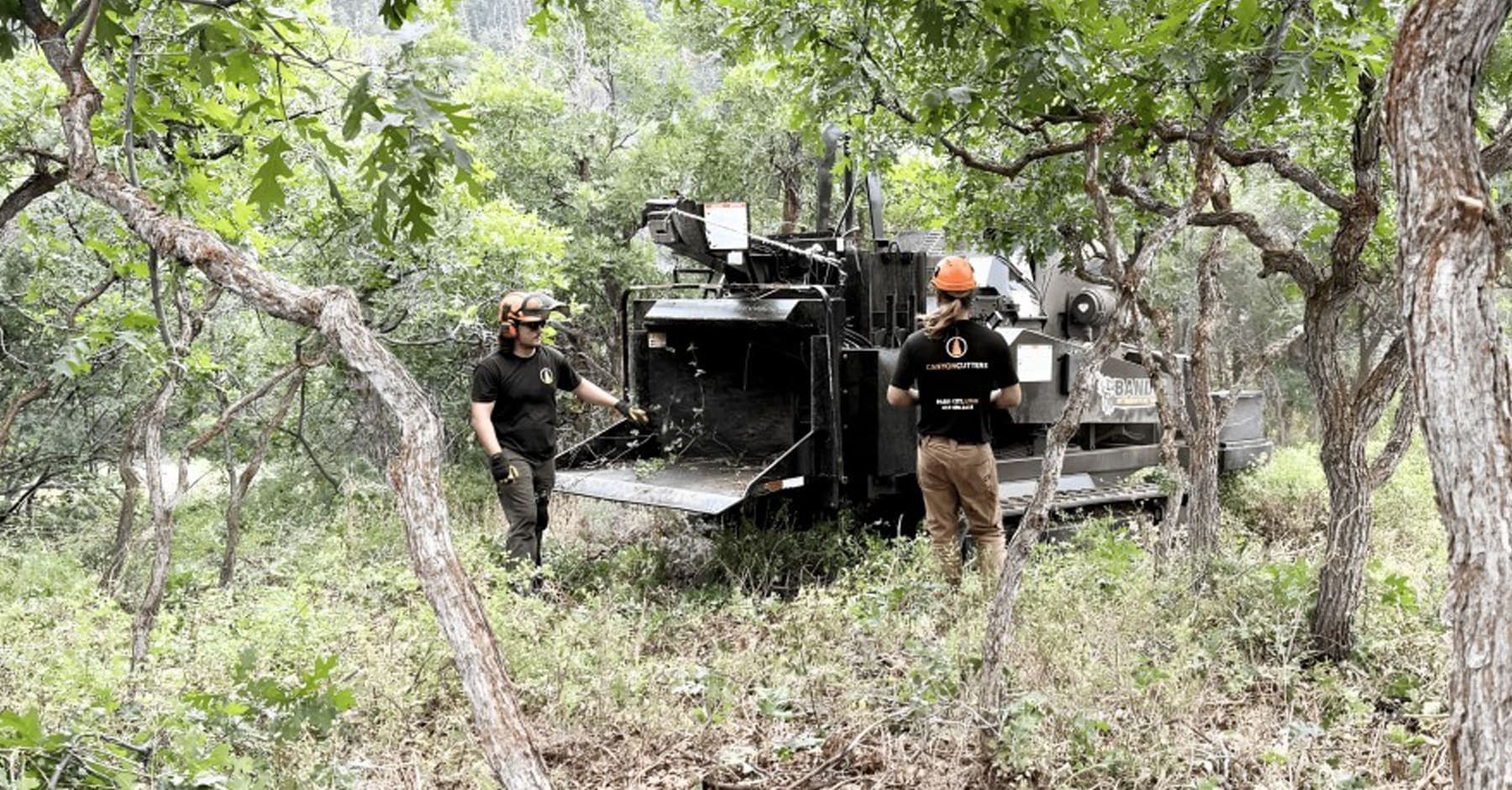
Tree Chipping & Debris Removal
October 22, 2026
Whether beetle-killed conifer is worth burning, how far Utah lets you move firewood (50 miles maximum, 10 ideal), which of your species is actually worth stacking, and the Summit County burn rules that catch almost everyone out.
Somewhere between the quote and the first cut, nearly every homeowner asks some version of it. Can I keep the wood?
The short answer is yes, it is your tree and your wood. The useful answer has more in it: whether beetle-killed conifer is worth burning, how far you are allowed to move it, how long it has to sit before it burns properly, which species is actually worth stacking, and — the part that surprises people — what the rules are if you were planning to burn the brush pile instead.
That last one matters on the Wasatch Back more than anywhere. Summit County has two narrow burn windows a year, the permit comes from a different agency than most people assume, and a seasonal fire restriction overlaps both windows.
Yes, and this is worth explaining because beetle-kill is a large share of what comes down on a Wasatch property.
That grey-blue discolouration through beetle-killed pine is a staining fungus the beetles carry in with them. It changes the colour of the wood and nothing else that matters for burning. As fuel it is fine. Furniture makers actually seek it out.
You are not trying to avoid stained wood. You are trying to avoid moving wood that still has live brood under the bark next to healthy trees. Extension guidance on this is reassuringly specific: a tree that has no foliage left, or foliage that has gone deep red, was killed in a previous year, contains no bark beetle brood, and is safe to cut, move and stack near live pines. By late August, trees that began fading that spring are also safe, because the beetles have emerged and gone.
The one to be careful with is a tree that faded this season and still has its bark on. That is where brood may still be present, and stacking it against the house next to healthy conifer is how an outbreak gets a free ride. Our bark beetle field guide covers how to read the fade.
Spruce is different from pine. Guidance for spruce-beetle material is to burn it before the following spring rather than season it for years. If what came down was Engelmann spruce rather than lodgepole, treat the timeline as shorter.
This is the genuinely regulated part, and the numbers are tighter than most people expect.
Utah has a firewood quarantine— Rule R68-23, administered by the Utah Department of Agriculture and Food — governing firewood brought into the state, alongside separate quarantines for emerald ash borer and spongy moth. Out-of-state firewood has to meet precautionary requirements including heat-treatment certification and labelling. Pests of concern include Asian longhorned beetle, emerald ash borer, spongy moth, spotted lanternfly and velvet longhorned beetle, all of which travel in wood.
For moving wood within Utah, the guidance is a distance, and it is short:
The campaign slogan is “buy it where you burn it”— which also means burn it where you cut it. For most homeowners this is academic, because the wood is staying in the back yard. It matters if you were planning to take a truckload to a cabin, haul it to family in another state, or bring camping wood home from somewhere else.
Fresh-cut wood is roughly half water by weight and will not burn properly. The target is under 20% moisture content, which generally takes six to twelve months split and stacked.
A moisture meter costs very little and removes the guesswork entirely. It is the difference between wood that heats the house and wood that smoulders, coats the flue and disappoints you all winter.
On the perennial “never burn pine” claim: the real problem is unseasoned pine. Well-seasoned pine burns hot and relatively clean, and creosote is driven far more by moisture and low flue temperatures than by species. Have the chimney inspected annually regardless of what you burn.
Heat output varies a lot by species, and on a Wasatch property you may have several coming down at once. USU Extension’s wood heating table puts the four species you are most likely to have here in this order:
Treat those as a ranking rather than precise physics. Published BTU figures differ noticeably between sources because moisture assumptions, wood density and how much solid wood a cord actually holds all vary — other tables put Gambel oak nearer 28 and aspen as low as 13.7. All of them assume dry wood: poorly seasoned wood yields roughly 18% less heat, which swamps the difference between species. Seasoning matters more than what you chose to stack.
If you are not sure what you have, our Utah tree species field guide covers identifying what grows at each elevation band here.
Burning a brush pile is legal in Summit County, and the rules trip people up in four separate places. Worth reading before you plan anything.
Summit County issues open burn permits only between March 30 and May 30, and between September 15 and October 30. Park City gives the same two windows for incorporated areas. Outside those dates there is no residential open burning, permit or not.
This is the one that catches almost everybody. The Park City Fire District does not issue open burn permits— the application goes to the Utah Department of Environmental Quality. A separate permit is required for each individual burn, not one per season. Once you hold a permit, you are also expected to call Summit County Dispatch before you light it, at (435) 336-3600, prompt 1.
The clearing index is an air-quality measure of how well smoke will disperse. It must be above 500 on the day you burn. If it drops below, permits issued for that day are void. The obligation to check sits with you, daily, not with the agency that issued the permit.
The permit also requires you to have considered whether there is a practical alternative to burning, to use methods that minimise emissions, and to supervise the burn. On material only: dry vegetation only, and no trash, rubble, tires or oil.
Here is where it gets genuinely confusing, and why the answer is a phone call rather than a calendar.
In April 2026 the Summit County Council backed seasonal restrictions on open burning and fireworks running May 1 through October 31 in unincorporated areas served by the fire districts, with Park City Municipal expected to align. As of September 2026, Stage 1 and 2 restrictions were no longer being enforced in unincorporated parts of the Wasatch Back, but the Park City and North Summit fire districts were still enforcing Stage 1inside their boundaries — no open fires except in established pits and campgrounds.
Lay that over the permit windows and the spring window effectively ends at May 1 in restricted areas, while the autumn window opens inside a restriction period that runs to October 31. So the dates on paper and the dates you can actually burn are not the same dates.
So before you plan a burn: check current restrictions with the Park City Fire District, confirm the window and the permit process with Utah DEQ, and call Summit County Dispatch on the day. Restriction stages change through the season, several of the published pages are a few years old, and a pile you cannot legally light is a pile you now have to chip anyway.
Which is the honest argument for chipping. It needs no permit, no window, no clearing index and no dispatch call, it does not put smoke over your neighbours, and it leaves you something useful.
On a typical removal, unless you tell us otherwise:
Tell us at the quote stage if you want firewood. Cutting rounds to 16 or 20 inches as we go costs nothing; coming back to re-cut a pile of eight-foot logs costs real money. Our 2026 pricing guide covers how disposal choices move the number, and keeping the wood does reduce it.
Canyon Cutters works across Park City, Heber, Midway, Kamas and the surrounding Wasatch Back communities, and what happens to the material is part of the quote rather than an afterthought. If you want firewood, say so early. If you want the chip spread on a trail, we can do that. If what came down is actively infested and should not sit on your property at all, we will tell you that too.
Reach out through our contact page or call (201) 960-8275. The first visit is free and the estimate comes in writing, with the disposal plan itemised rather than buried.
Burn windows, permit procedures, restriction stages and quarantine rules change, and several of the published pages behind this article are some years old. Confirm current requirements with the Park City Fire District, Utah DEQ and the Utah Department of Agriculture and Food before burning or moving wood. Firewood BTU figures are from published tables and vary by source; treat them as a ranking rather than a measurement.
Tags
Free Consultation
Tell us about your land and we'll set up a free on-site visit and walk it with you.
ISA Certified Arborist · Licensed & insured · Free, no-obligation estimates